President Trump recently announced that a diplomatic agreement with Iran has been mostly negotiated, but the waters remain murky. As usual in international relations, things are never straightforward, and there are whispers that Iran may not be on the same page. The question that looms over all this is whether the two sides are inching closer to peace or merely playing a game of chicken.
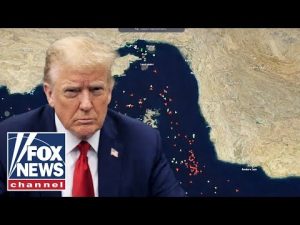
The negotiations are complicated, with President Trump suggesting that an agreement would involve reducing hostilities, allowing for some gradual sanctions relief, and getting the ball rolling on further discussions about various issues. Many observers have been on edge, wondering if Iran’s government can truly reach a consensus. Notably, the Iranian Revolutionary Guard seems eager to keep a tight grip on control, particularly over the Strait of Hormuz, a critical waterway for international shipping. It’s like trying to negotiate with a cat: no matter how many treats you offer, they might just hiss and walk away if they don’t like the arrangement.
Retired Lieutenant Colonel and author Darren Gob weighed in on these negotiations. He expressed concern over the two main sticking points: Iran’s control of the Strait and its nuclear enrichment program. If these issues can’t find a peaceful resolution, military options could come back into play. However, any talk of military action raises eyebrows—after all, it’s not like sending in the troops is a decision made on a whim. It’s more akin to a game of chess, where every move counts and the stakes are astronomically high.
Both Fred Fleitz, a former NSC Chief of Staff, and Darren Gob seem to agree that pressure may need to be applied to convince Iran that its nuclear ambitions will not be tolerated. Fleitz mentioned that rather than engaging in a risky excavation to retrieve Iran’s enriched uranium, the U.S. might have to send a strong message saying that if Iran attempts to restart its nuclear program, there would be severe consequences. It’s like telling a kid who keeps sneaking cookies that if they don’t stop, they’ll have to face the dreaded “no dessert” rule.
The elephant in the room is the role of Israel in these negotiations. Trump’s discussions with Gulf leadership and Israeli Prime Minister Netanyahu highlight a delicate balancing act. Israel has a vested interest in ensuring that Iran doesn’t regain any nuclear capabilities or influence in the region. For Israel, the priority is clear: prevent Iran from using its proxies, like Hezbollah and Hamas, to threaten their security. If negotiations falter, it raises the real possibility of renewed hostilities—and nobody wants to see that.
As the situation unfolds, it’s clear that while progress might have been made, the risk of reverting to conflict looms. The world watches with bated breath, hoping that diplomacy wins out over military action. The coming hours will tell if the parties involved can get their ducks in a row or if they end up at loggerheads again. In the meantime, the stakes remain high, and the clock is ticking.