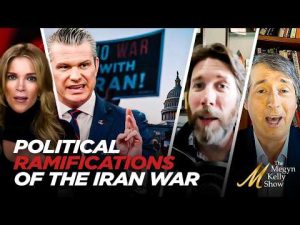
In the world of international politics, where every move carries weight and every decision echoes through history, the question of America’s approach to Iran is once again at the forefront. The scenario laid out here showcases a complex tapestry of military objectives, political maneuvers, and the ever-present search for a path that safeguards American interests while avoiding endless entanglements. President Trump’s administration finds itself at a critical juncture, where the need for a decisive exit strategy from Iran is paramount, yet dauntingly intricate.
The discussion suggests that Trump’s administration might declare victory and cut its losses, citing significant achievements like the removal of the Ayatollah and crippling Iran’s nuclear ambitions. Surely, on paper, this appears desirable—give the Iranian people a chance, step back, and let regional actors, possibly Israel or others, take up the task if they so wish. However, untangling the United States from this situation requires more than mere declarations; it necessitates a deft combination of diplomacy and strategic foresight.
Internationally, there is talk of Qatar and the United Arab Emirates potentially assisting the U.S. in finding a diplomatic exit. This indicates that some regional actors recognize the need for stability over chaos. The evolving dynamics suggest that Iran, recalling past mistakes, might intensify martial efforts for fear of future attacks. However, such escalation could push America further from diplomacy and deeper into military involvement—a scenario the American public, largely weary of foreign entanglements, might not support.
The crux of the matter lies in whether the U.S., having invested so much in this geopolitical chess game, can strategically maneuver to avoid on-ground troops while ensuring Iran cannot boast of an unequivocal victory. Public opinion reflects a desire for a Republican Party that champions restraint, not a return to past decades of military interventionism. The conversation brings to light a critical truth: Americans may support taking out nuclear threats, but not at the cost of entrenching ground troops and nation-building efforts echoing the early 2000s misadventures.
And then there are the Iranian people—a populace with diverse desires for governance yet constrained by a historically authoritarian culture. While there is a flicker of hope for democratic ideals, especially among certain secular circles, the broader sociopolitical fabric remains complex. Transforming Iran into a Western-style democracy would require more than external force; it demands internal shifts and a conducive environment, something beyond the reach of foreign powers alone.
Thus, America’s strategy must balance the intricacies of geopolitical stability, military might, and diplomatic finesse. The ultimate question is not just whether the U.S. can exit effectively, but if it can do so in a way that leaves the region more stable and the American public assured that their future won’t be another conflict across the globe. The call is for a smart, calculated approach, reflective of restraint and respect for international complexities—qualities that align with America’s deeper values and long-term interests.