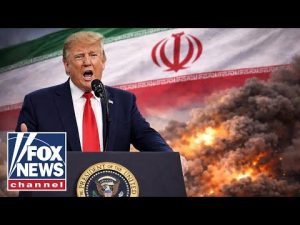
In the age-old game of geopolitical chess, President Trump is doubling down, and the stakes have just gotten higher. In a bold move, President Trump has announced that the U.S., along with its allies, will be dispatching warships to the Strait of Hormuz to ensure the continuous flow of oil—a pivotal strategic maneuver to counter Iran’s latest antics. The drama escalated with a fresh overnight video showcasing U.S. forces unleashing a barrage on Iran’s Kar Island, an essential hub for the country’s oil exports.
Kar Island wasn’t just pounded like it was an opening night pinata; the message was clear: Iran, play nice, or face the consequences. In what he described as a “strictly military” operation, the president warned that if Iran doesn’t shape up, the list of targets could grow longer. This isn’t just about the explosive visuals but the less-than-explosive reality that, without Kar Island, Iran’s economy would start to sputter like an old lawnmower on its last legs. With Iran depending on this island for a whopping 90% of its oil exports, the economic vice is tightening, and it’s high time for Iran to take a hint.
Additionally, over 2,000 Marines are being mobilized from the Pacific, ready to deploy somewhere in the region. Exactly where these boots will touch the ground is still wrapped in mystery, as if it were the world’s worst-kept secret. Steve Harrian, reporting live from the Armenia-Iran border, assures everyone that the strategic location of these Marines remains as uncertain as a weather forecast. But let’s face it, the main takeaway here is President Trump’s signal of intent—a no-nonsense approach to securing the Strait.
On the other side of the punditry, former Defense Secretary Mark Esper is pouring a glass half-full as he praises this multinational move. By drawing in other countries, especially those who feel the oil pinch hardest, it adds that diplomatic razzle-dazzle everyone loves. With more warships, we get more collective muscle in the region. Because, evidently, being the world’s most capable navy has its limits, like a Wi-Fi signal that just won’t reach the back room of your house.
Of course, amidst all this military muscle-flexing, one can’t help but wonder how the Iranians are faring. Secretary Esper warns that Iran appears emboldened, claiming victory in having weathered the initial storms. There are murmurs of reparations, and pleas for the U.S. to pack up and go home—as if this were some casual sleepover gone awry. While war is a contest of wills, Esper’s assertion remains clear: democracies may bow to public opinion, but a regime change, albeit necessary, is a complex quagmire not easily navigated.
So as the world turns its eyes towards the Strait of Hormuz, the oil prices, and those pesky November elections, one thing is certain: this saga is far from over. Diplomacy may offer an off-ramp, but until then, the blaring sirens of world politics remind Iran—and the rest of us—that the U.S. is ready to square off in the high-stakes game of international brinkmanship.