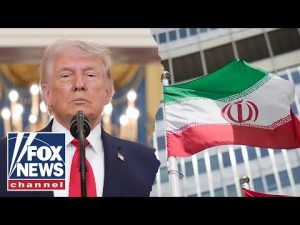
The intricacies of diplomacy seem lost on some people these days. Look at the scenario unfolding between the U.S. and Iran. Here we have folks on one side trying to negotiate in good faith, while on the other side, the Iranian regime appears to be playing chess on a maximalist strategy. This is not a friendly game of bridge, folks. We’re talking about international relations, with the Straits of Hormuz playing a central role in all the drama.
President Trump’s recent comments highlighted the complexities of dealing with a regime that places a high value on gaining the upper hand rather than engaging in genuine dialogue. While Trump’s remarks have stirred concern about possible military actions, the real eyebrow-raiser is the nature of these potential negotiations. It seems the Iranian regime, steeped in its own endeavors, doesn’t put much stock in talk unless it directly benefits them. Their track record doesn’t scream “good faith partner” in big bold letters.
Now, before anyone jumps to any radical conclusions, it’s worth noting that the U.S. military sticks to international law like glue on a craft project. There’s no insinuation of war crimes here, just the usual diplomatic tit-for-tat. Yet this begs the question: If infrastructure is threatened, who’s really feeling the heat? Not the regime, that’s for sure. The ruling elite seem blissfully unconcerned about the well-being of their nation’s infrastructure, or sadly, its people. Talk about a government that cares more about its own skin than the foundation it stands on.
In this game of international chicken, one wonders if there is any pressure point that could make Iran’s regime realign its priorities. Can a selected military target tilt the scales? Or will parts of the infrastructure withstand until the people bear more of the brunt than they already do? Sadly, history shows that regimes adept at shifting blame and burden often weather such storms, much like Hamas in Gaza, shuffling the suffering onto the civilian populace.
Yet the question remains: how long will the people accept this state of affairs? There’s always a boiling point. One day the people might just have enough and decide it’s high time they got into the driver’s seat of their own fate. Until then, it seems, the international community must balance caution with strategy, watching and waiting for the day when the tables turn, and the Iranian people decide to take bold steps to reclaim their country’s future.