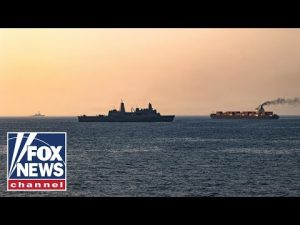
In what seems like an action-packed drama straight out of a high-seas thriller, the United States has embarked on “Operation Epic Fury.” Can we take a moment to appreciate the dramatics and flair seemingly inspired by comic books? The mission aims to assist ships trapped in the Strait of Hormuz, an area not exactly known for its hospitality to Western vessels. The president, in an act of branding genius—or fantasy, depending on whom you ask—has christened this mission “Project Freedom.” Oh, the irony it must give certain leaders halfway across the globe.
Recently, a second UK ship reported being attacked in this high-stakes waterway. Perhaps inspired by countless pirate-themed movies, these attacks have led to a standoff involving the U.S. Central Command. Officials, standing tall with their chests puffed, are denying Iranian reports of an attack on a U.S. warship. Meanwhile, the White House is attempting to unclog this maritime highway, which one might liken to rush hour with a side of international tension.
As this unfolds, the president has been busy posting online—some might say from the comfort of his padded Oval Office chair—declaring this effort as a humanitarian mission. His posts would have the world believe that the U.S. is simply playing the good neighbor, guiding ships safely to resume their pursuits of commerce and freedom. It paints a picture of noble sea-faring heroes venturing out to face the perils of international waters. Added to this fantasy, the Joint Maritime Information Center is instructing ships to stick to the Omani side of the waters, dubbing it an “enhanced security area.” You can almost hear the grand soundtrack playing in the background.
Of course, Iran is not impressed. The head of Iran’s parliament mocks these “delusional” posts, claiming they manage the waters just fine without American interference. The narrative spins further when Washington claims Iran is on the economic ropes, unable to find enough storage for their oil. One can almost imagine the cluttered Iranian oil barrels stacking up like an oversized game of Tetris.
The United States, confident in its plans, is deploying a smorgasbord of military might, from guided missile destroyers to unmanned drones. The buzz of these mechanical bees, however, does not seem to unsettle Tehran, which maintains its poker face. As this transpires, negotiations continue, although it’s not entirely clear on what. Rumors swirl about uranium enrichment deals, ships moving through ominous waters, and the noble aim of stabilizing global energy markets. At the heart of it, the U.S. insists that Iran ponders twice before taking any aggressive action, suggesting that any offensive move by Iran could be more perilous than a stick fight at a beekeepers’ convention.
In the end, this naval drama on the real-world stage may ultimately prove a win. The spectacle promises to delight the audience, albeit in a tense and unsettling way. If nothing else, it offers a masterclass in diplomacy wrapped in warfare, with each side playing their cards with a theatrical flair befitting of a Cold War-era spy novel. For now, it’s game on; the seas ruffle, the flags wave, and the ships continue their daring dance in the Straits of Hormuz. Stay tuned, the plot, as they say, thickens with every tweet and post.