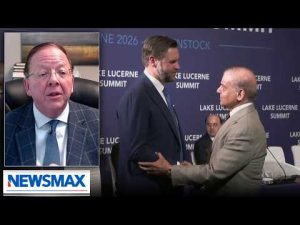
In a drastic turn of events, tensions are escalating once again in the Middle East, and this time the chessboard sits on Swiss soil. The Vice President of the United States is currently negotiating with an Iranian delegation in Switzerland, marking a significant but perplexing moment for political analysts and concerned citizens alike. As the discussions unfold, many are left wondering: are we inching closer to peace, or are we simply delaying an inevitable clash?
The stakes couldn’t be higher, especially with critical issues swirling around the U.S.’s relationship with Iran. The Vice President has made it clear that President Trump is committed to achieving a full regional ceasefire, indicating a potential desire for a fresh start with Iran. However, some experts are doubtful. They liken the situation to a beloved children’s book, “The Giving Tree” by Shel Silverstein. The analogy suggests that just like the tree in the story, America’s relationship with Iran has been stripped bare, leaving behind nothing but a lonely stump—a rather dire outlook for what could be a pivotal diplomatic moment.
As negotiations unfold, it’s essential to understand that the battlefield has shifted from the physical realm to the negotiating table. The issues at play are more than just about ending hostilities; they revolve around the intricate balance of power in the region. A crucial point of contention is the Strait of Hormuz, a pivotal waterway for global oil transportation. Iran’s past threats to impose tolls on ships passing through have raised alarms, and President Trump has warned that if tolls are to be charged at all, it will be the United States collecting them, not Iran. The potential for turmoil in international shipping is significant, as any shift in control could reshape the geopolitical landscape.
Moreover, the question of Iran’s continued uranium enrichment looms large. The Iranian president has made it clear that this enrichment will persist, a move that has ruffled feathers and led to increasing tension. With negotiations reportedly resembling the halftime of a football game, experts warn that we may be in for an extended deliberation phase, reminiscent of a long-winded halftime show.
Adding to the complexity, the negotiations are not solely about U.S.-Iran relations. Tensions with Israel and regional dynamics further complicate the discussion. Iran’s strategy appears to be an attempt to drive a wedge between the U.S. and Israel, exploiting their adversarial relationship to its advantage. This push and pull creates a precarious situation where any misstep could easily tip the scales into chaos rather than cooperation.
It’s clear that there are far-reaching implications to consider. The recent ebb in tensions has inadvertently provided Iran with breathing room, especially as nations like China are ready to pounce on any opportunity to support Tehran. As diplomatic discussions proceed, the U.S.’s leverage wanes, raising concerns about the future of the region and the balance of power. With each passing moment, the possibility of returning to a precarious status quo becomes more likely, much to the dismay of those who desire a stable solution.
America stands at a crossroads, and as these high-stakes negotiations continue, both leaders and citizens alike will be watching closely to see if a meaningful agreement can emerge or if the negotiations will merely serve to buy time before the next upheaval. With all eyes on Switzerland and the potential fallout, the hope for peace hangs delicately in the balance.