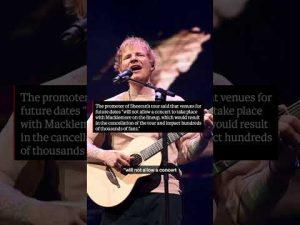
In today’s cultural landscape, where the line between entertainment and politics continues to blur, a recent incident involving the artist McLemore serves as a case study in attention-seeking behavior. McLemore, once heralded for his hit “Thrift Shop,” has descended into the shadowy depths of irrelevance. Yet, in a bid to reclaim his fame, he targeted an unexpected platform: a concert opening for Ed Sheeran. The catch? He chose to incite controversy by labeling Israeli actions in Gaza as genocide, effectively jumping into the political fray that has become the hallmark of public discourse today.
The response from Ed Sheeran and the stadium’s owner, Robert Kraft, was swift and decisive. Kraft stands firm, stating that the Gillette Stadium will not serve as a backdrop for hate speech. With notable conviction, he declared that promoting incendiary rhetoric—whether unsubstantiated or not—within the confines of his venue crosses an important line. His commitment stems not from a place of political correctness, but from a deeply-rooted respect for the Jewish community who have faced significant hardships and historical injustices.
McLemore’s outburst was, of course, aimed at reviving his career, riding the wave of contemporary political wokeness. Artists like him have discovered that mere provocative statements at concerts can draw attention—good or bad—to revive failing careers. One can hardly blame Kraft for distancing himself from someone attempting to inject bitterness into the public sphere. The decision to boot McLemore from the concert was not merely a rejection of a musical act; it was a rejection of his attempt to manipulate public sentiment for personal gain.
Nevertheless, McLemore has since attempted to mend bridges, asserting a long-standing friendship with Sheeran while doubling down on his message. This is indicative of a larger trend among certain celebrities who prioritize political statements over personal relationships. The dilemma becomes stark: can one be so devoted to a cause that they alienate friends, family, and fans? McLemore’s situation exemplifies this precarious balancing act. His insistence on “telling the truth” about the conflict, while attempting to discredit Sheeran’s perspective, illustrates his lack of awareness of the broader implications of his divisive rhetoric.
In the entertainment industry today, speaking out against Israel is often lauded while pro-Israel sentiments can lead to professional ostracism. This paradox speaks volumes about cultural attitudes toward complex international issues. McLemore has unwittingly thrust himself into this treacherous arena, where expressing opinions can generate immediate fame but also enduring backlash. The irony is not lost on anyone: an artist clawing for relevance in a world where political issues can either elevate a platform or bury it.
While McLemore may relish the limelight, it remains crucial to uphold a standard of truth rather than sensationalism. The severe ramifications of misinformation can fuel further division in an already polarized society. As this saga unfolds, it serves as a reminder of the cultural responsibility artists bear in voicing their opinions on complex matters. Consequently, McLemore’s foray into controversy may eventually fizzle out just as swiftly as it ignited, leaving a question lingering: does anyone truly care what McLemore thinks about global politics? Only time will tell, but it appears a resurgence built on divisive rhetoric is a shaky foundation for a career.