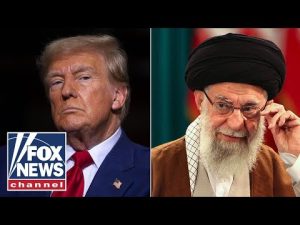
In the ever-evolving landscape of international politics, the latest developments concerning Iran and Israel present a compelling narrative worth exploring. Senator Bill Hagerty, a member of the Senate Foreign Relations Committee, recently shared his insights on a significant military operation known delicately as Operation Midnight Hammer. The operation aimed to dismantle Iran’s nuclear and ballistic missile capabilities, and according to Hagerty, it was executed with the finesse of a master craftsman.
Hagerty expressed his belief that the current Democratic leadership has missed the boat on understanding the seriousness of the situation. To him, their criticisms of President Trump’s approach seem more like political theatrics than genuine concern for global stability. This is a classic case of politicians being so consumed by partisan politics that they can’t see the forest for the trees. Hagerty pointed out that the successful strikes on Iran were not just about eliminating nuclear threats; they were intended to safeguard not only the U.S. but also international commerce that flows through the region. In his eyes, this strategy is effectively avoiding a full-blown war with a country known for its erratic leadership.
Despite the chaos that often accompanies such military endeavors, the senator painted a picture of optimism regarding the immediate future of Iran. With the recent strikes taking out substantial parts of Iran’s military infrastructure, Hagerty believes the Iranian Revolutionary Guard’s grip on power is now significantly weakened. The operation resulted in Israel conducting a high-stakes aerial maneuver, which Hagerty characterized as “200 jets coming in” to execute airstrikes. This decisive action has opened up the airspace over Iran and has set the stage for both Iranian citizens and the international community to reconsider their next steps.
What’s particularly interesting is Hagerty’s assertion that President Trump has extended an olive branch to the Iranian people. The senator characterized this as a once-in-a-generation opportunity for the citizens of Iran to reclaim their country. The call was clear: Iranian leaders must lay down their weapons or face dire consequences. This strategy, he suggested, aligns with the broader goal of stabilizing the country and encouraging democratic reforms among its people. The message is straightforward: there’s room for a new beginning if the Iranian military leadership can come to the negotiating table peacefully.
As Iran stands at a crossroads, the question looms: how will the nation navigate the coming weeks? Senator Hagerty remained hopeful that the infrastructure among anti-regime citizens was already in place, waiting for the right moment to spring into action. With credible intelligence and ongoing support from the U.S. and allies, the pieces might just be in place for a significant transformation in the country. As history has shown, moments like these can either spell disaster or offer a glimmer of hope for the people yearning for change.
In a world where the complexities of international relations can often seem overwhelming, the narrative surrounding Iran offers a stirring reminder of the power of decisive action combined with calculated diplomacy. As the winds of change blow through the Middle East, the implications of these events may extend far beyond the immediate players involved, redefining relationships and power dynamics for years to come.