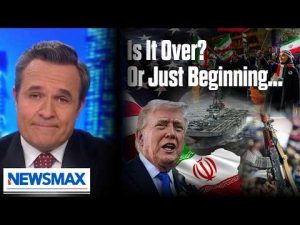
In the ever-changing landscape of global politics, the situation in Iran has grabbed headlines and raised eyebrows. After around 30 days of significant military engagement, many are asking if this involvement is just the beginning of a long and arduous conflict or merely a brief chapter in a larger story. With statistics indicating that most wars last about three years, it seems this venture may be just a tiny fraction of what could lie ahead.
The recent developments paint a striking picture of what has taken place so far. President Trump’s initial statements suggested a timeline of four to six weeks for decisive action, which many are beginning to wonder if that could have been too optimistic. Key Iranian military infrastructure, including their navy and missile capabilities, has reportedly faced substantial damage. Additionally, the nuclear threat posed by Iran has also been considerably diminished. Yet, as one might expect, with great successes come new uncertainties. The question on everyone’s mind is: who exactly is steering the ship in Iran now that its leadership structure has become unstable?
This uncertainty becomes even more tangible when one considers the power vacuum left behind. Following the removal of significant figures like Ayatollah Khamenei, a pressing question arises: who is in charge of Iran now? With the absence of clear leadership, it becomes challenging to establish a point of contact for negotiations—particularly for the Gulf States who previously had defined entities to engage with. In contrast, when Iraq was invaded in 2003, the intent was to decimate Saddam Hussein’s regime; unfortunately, that operation became a protracted endeavor with many leaders evading capture for years.
Taking a broader look, President Trump’s military approach evokes memories of his consistent claims regarding oil in the Middle East. He often brought up the idea that past engagements, particularly in Iraq, should have resulted in seizing the region’s oil reserves. It was a strategy that, had it been executed, might have altered the dominant power dynamics in the region. Now, some speculate whether the current military operation has similar motivations lurking beneath the surface—especially considering how vital oil is to nations like China.
As the stakes rise, the intertwining of energy politics and global relations becomes ever more apparent. With the U.S. fully capable of producing its own oil, the decision to pursue Iranian oil could provide a bargaining chip in negotiations, especially concerning China’s interests in Taiwan. The uncharted waters pose both risks and opportunities. What happens if Iran’s oil becomes a tool of leverage against a nation that heavily relies on it? While no one wishes for conflict escalation, the practical implications of control over energy resources could have significant ramifications in global relations.
As the situation continues to evolve, the crucial task remains to find clarity amidst uncertainty. The veil of who leads Iran and what their intentions are will play a pivotal role in determining the future course of action. It’s a chess game on a grand scale, and the pieces are moving faster than anyone anticipated. The world watches closely, hoping for peace but preparing for the unexpected. It’s a classic theater of geopolitics—a strange mix of strategy, negotiation, and sometimes, just good old unpredictability.