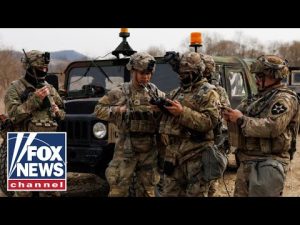
In the Middle East, there is a virtual tug-of-war taking place, and the stakes could not be higher. At the center of it all is Iran, playing a high-stakes game over nuclear inspections. Meanwhile, President Trump has rolled out what can only be described as the ultimate insurance policy: a formidable naval presence that practically screams, “Try us, and you’ll regret it.” This power play sends a clear message, putting pressure on Iran to come to the negotiating table, even as tensions simmer over potential military strikes.
As if to underscore the tense atmosphere, the USS Abraham Lincoln is stationed ominously in the region. The Pentagon’s recent steps to bolster air defenses underscore the heightened concern about a retaliatory strike from Iran. Talk about a neighborhood watch program! The administration seems to be taking every precaution to protect U.S. allies and interests. The presence of destroyers and stealth fighters stands as a deterrent, forming what one might call a “golden dome” of protection over thousands of American forces.
Meanwhile, the armchair generals and real ones alike are debating the right course of action—or inaction. General Jack Keane sees an opportunity for seismic change in the Middle East, suggesting that a decisive military strike could push Iran’s regime toward collapse. Yet, this isn’t envisioned as another war with boots on the ground, but rather a precision operation targeting missile sites and other strategic assets. Certainly, there are no invitations being sent for a ground-party reminiscent of past misadventures in the region.
There’s a recurring theme here: the delicate dance between diplomacy and force. Leaders from Egypt, Qatar, and Turkey play the role of mediators, urging Iran to rethink its obstinate stance. However, for those who have followed Iran’s playbook over the years, there’s no surprise if actual results are only yielded when a little bit of tough love is applied. The lesson from the past is simple—sometimes a negotiation needs the looming threat of a hammer to drive the point home.
As talks and tensions continue, it’s a waiting game to see whether reason prevails or military action becomes the order of the day. One thing is for certain: underestimating the current administration’s willingness to use its formidable arsenal could be a grave mistake for Iran. With every military asset strategically placed, it seems Iran has been left with very little wiggle room. The clock is ticking, and all eyes are on Tehran, watching, waiting, and hoping for a peaceful resolution. Or else, one might imagine, it’s lights, camera, and action time on the world stage, courtesy of the forces parked right in Iran’s neighborhood.