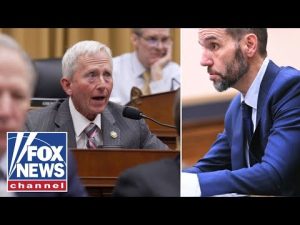
The political stage was set for a riveting showdown in the House Judiciary Committee as Congressman Kevin Kiley faced off against Special Counsel Jack Smith. It was an event that promised to deliver fireworks, and it did not disappoint. Kiley, fired up and ready to go, took on the formidable task of scrutinizing Smith’s controversial tactics, particularly his aggressive approach to obtaining phone records from Congressional members. The stakes? Higher than a giraffe on stilts, as this inquiry touched on fundamental issues regarding government overreach and constitutional rights.
Kiley opened the hearing with a flurry of questions that made it clear he wasn’t there to play nice. It was evident from the get-go that he believed the powers wielded by a special counsel should come with a hefty dose of responsibility. Kiley pointed out that Smith’s approach had not just raised eyebrows but also had prompted intervention from higher courts, even prompting the Department of Justice to rethink its policies. One needs to appreciate the gravity of the situation. Members of Congress having their phone records seized is no small matter—and it is sure to raise alarms about privacy violations and the power dynamics within the government.
As the committee deliberated, Kiley punctuated his arguments with keen observations about Smith’s demeanor. Throughout the questioning process, Kiley noticed that Smith appeared to fidget and hesitate, signs that suggested he might have something to hide. Body language experts might have had a field day analyzing his performance, much like one might analyze a suspect caught in a lie. The tension was palpable, and it felt as if Kiley had the upper hand, methodically dissecting the accomplishments—and shortcomings—of Smith’s career in front of a captivated audience.
The discussion quickly turned to the troubling issue of Smith’s investigation tactics, specifically his acquisition of phone records from members of Congress without notifying them. Kiley expertly framed the conversation, emphasizing the potential constitutional violations inherent in such actions. Imagine a game of chess where the rules are bent so far that it feels more like two players playing two different games. One side is following the rules, while the other is busy rewriting them to serve its own purposes. Kiley hammered home the notion that the very principles of a divided government were at stake, an issue that should send shivers down the spine of any politician or citizen concerned about liberty.
As the hearing progressed, hints of future reforms hung in the air like a tantalizing mystery. Kiley suggested that this might just be the beginning of necessary changes to how special counsels operate. There was an air of determination, a sense that oversight might soon yield legislative changes to rein in excessive power. The implications of Smith’s actions could spur deeper conversations in Congress, ensuring that the powers vested in special counsels remain balanced and in line with the will of the people.
In the end, hearing Kiley take Smith to task might have felt like watching a heavyweight boxing match where the underdog takes the champion by surprise in the final round. The hearing was not attended by the media fanfare typically associated with high-profile investigations, yet it held significant potential for how governance operates in America. Kiley, with his tenacity and sharp questioning, may have just laid the groundwork for monumental changes—a victory for accountability and perhaps, just perhaps, a reminder that no one, not even a special counsel, is above the law.