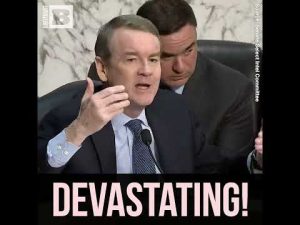
In a recent confrontation that has shaken the political landscape, tensions erupted during a discussion on refugee welfare programs. The exchange highlighted not only the deeply rooted divisions within government but also the increasing normalization of political violence. This incident serves as a stark reminder of the volatile nature of contemporary politics, where personal safety and political values frequently clash.
The focus of the disagreement was a member of Congress who has experienced severe violence as a result of political tensions, having suffered from a brutal assault that left him with six broken ribs and a portion of his lung removed. This Congressman confronted another political figure— the Secretary of Homeland Security—over the Secretary’s perceived acceptance of the violent actions taken against him by a felon known for his anti-Trump sentiments. What should have been a straightforward policy discussion spiraled into a heated debate about the implications of endorsing or simply understanding violence.
As the Congressman emphasized, it is not just the physical assault that is alarming; it is the lack of accountability and remorse shown by the Secretary. Instead of denouncing the attack unequivocally, the Secretary claimed to “understand” the motivations behind it. This ambiguous stance raises critical questions about leadership and the moral responsibilities of those in high office. When leaders refuse to outright reject political violence, they send a dangerous message: that such actions can be rationalized or tolerated in the heat of political conflict.
The Congressman insisted that the blurring of lines between understanding and justifying violence is a grave concern, especially for institutions like ICE and Border Patrol, whose men and women put their lives on the line to uphold the law. By simply acknowledging the attack without condemnation, the Secretary potentially emboldens those who might consider violence a viable form of political expression. This type of language from leaders in power can severely undermine respect for law and order, setting a troubling precedent for future political disputes.
Throughout the exchange, the Congressman maintained that political differences should not excuse or justify violent actions. In a world where rhetoric and actions can provoke real danger, leaders must commit to denouncing violence in all its forms. When they fail to do so, they contribute to an atmosphere of fear and division that affects not only their colleagues but also the broader public.
Ultimately, this incident not only highlights the urgent need for strong, principled leadership but also illustrates a larger cultural struggle. As conservative values face relentless attacks, it is crucial for leaders to stand firm against violence and promote dialogue grounded in respect, rather than fear. The American people deserve representatives who prioritize safety and moral integrity, rejecting the notion that violence can ever be a legitimate means to an end. In doing so, they will help restore faith in the political process and fortify the pillars of democracy that are so vital to the nation’s survival.