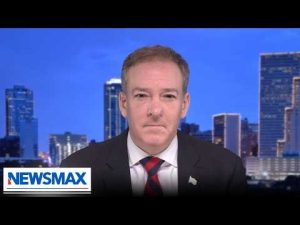
In the great state of Texas, a firebrand by the name of Brandon Gill is stirring the pot when it comes to government funding of non-governmental organizations, often casually referred to as NGOs. The curious case of these NGOs lies in their name—non-governmental—yet, many of them are belly-deep in government cash, making people wonder if they should be rebranded as “mostly-government” entities instead. Gill has taken the lead to demand more accountability from these groups, especially when it comes to how they spend the taxpayer dollars that flow to them like water from a broken dam.
Recently, guidance from the IRS highlighted the importance of nonprofits ensuring they know their grant recipients. This means that if a grant recipient breaks the law or tramples on the rights of Americans, the nonprofit is on the hook. It’s a no-nonsense approach championed by Gill, who recalls his experiences while working under the Trump administration, where he was part of the Corporation for National Community Service. During that time, he discovered a world where millions of taxpayer dollars were funneled to organizations that provided aid to illegal immigrants—something that the Trump administration explicitly opposed. This led to Gill making quite a few waves by shutting down those grants, proving that accountability isn’t just a buzzword, but a necessary demand.
Now, one might wonder how this peculiar cycle works. The government taxes citizens at what can feel like gunpoint, whisking away hard-earned dollars that could have gone toward family dinners or college savings. These funds are then doled out to NGOs, often with little to no oversight. It’s like handing your neighbor a check to mow your lawn while never checking if they even own a lawnmower. Left unchecked, many of these NGOs have found ways to engage in activities that could be deemed illegal or politically charged, such as facilitating the immigration process for those living in the U.S. without authorization.
While on the surface, these NGOs may profess to support humanitarian efforts, the implications of their work can be far-reaching and detrimental to American workers. Many Americans find themselves competing for jobs against foreign-born workers, who are rapidly increasing in the labor force. In fact, statistics show that more than half of the growth in U.S. labor is coming from these foreign entities. This causes quite a ruckus for young Americans seeking entry-level jobs that have now been snatched up by those who may be in the country illegally.
And let’s not forget the more nefarious side of some NGO activities. It seems that a portion of the funding ends up lining the pockets of protesters, who are then bussed to rallies where they drum up public dissent against Immigration and Customs Enforcement (ICE). This creates the illusion of widespread dissatisfaction with immigration enforcement, an idea that is far from the reality most Americans experience. It’s a complex web of funding and protest, and the average American taxpayer is left wondering why their hard-earned money is supporting causes that seem fundamentally at odds with national interests.
As Gill presses forward with this initiative, his message is crystal clear: Taxpayer dollars should not bankroll organizations that operate outside the law or that incite unrest. The citizens of America deserve transparency and accountability for how their taxes are spent. Gill finds himself on the front lines of this battle, fighting not just for financial responsibility, but for the very principles upon which this nation was built. After all, in the grand tapestry of American democracy, it’s the freedom to choose how to allocate one’s hard-earned money that allows citizens to truly participate in the fabric of American life.