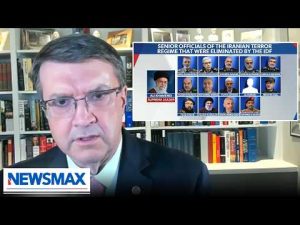
In recent days, the situation regarding the conflict in Iran has escalated in ways that have many political analysts buzzing. The U.S. military has launched a significant operation against Iranian leadership, and the fallout has been felt across the region. Renowned military expert and former Under Secretary of Defense Robert Wilkey recently commented on this unfolding military action, which is taking place under a tense cloud of historical conflict and current geopolitical maneuvering. It seems that the Iranian regime, known for its fiery rhetoric, may have underestimated the resolve and capabilities of its adversaries.
The Iranian military, long believed to be a formidable force, has shown signs of weakness. Over the last two days, it has launched only a meager 35 ballistic missiles into Israeli airspace. These numbers indicate a significant degradation of their military capabilities. One might say that, if the Iranian leadership is down to their third and fourth tier of commanders in their desperate attempts to retaliate, they have certainly lost a few chess pieces in this high-stakes game. What’s especially telling is that one missile resulted in the injury of 11 Israelis, with one tragic loss of life. It seems the U.S. military’s concerted efforts have effectively dismantled much of Iran’s ability to respond with the same ferocity as in previous years.
Wilkey highlighted an essential aspect of aerial warfare: when you see fewer missiles being launched in reaction to an assault, it usually means the enemy’s capabilities have significantly diminished. Instead of a vast barrage of missiles, which was more typical in the past, the Iranian military seems to be relying on sporadic and isolated attacks, hinting at a state of disarray and disorganization among their ranks. This raises questions about who is currently at the helm of the Iranian military command—certainly not the top brass, many of whom have reportedly been taken out during this intense military campaign.
However, the danger isn’t entirely gone. The Straits of Hormuz remain a hotbed for potential conflict, particularly given that Iran still possesses the ability to deploy naval mines. This could potentially ground shipping traffic to a halt. Interestingly, in recent years, the U.S. has allowed its own capabilities in the region to atrophy, relying more on partnerships with allies like the British and the Dutch. While this might be strategic, it’s clear that if tensions escalate further, the U.S. might find itself in a bit of a pickle if it can’t rapidly deploy its own resources.
One of Wilkey’s most striking observations involves the hubris of the Iranian leadership. They had the audacity to hold a high-level meeting of their top commanders on Shabbat, seemingly forgetting that their operations were compromised. This reckless display of arrogance could very well go down in the annals of military blunders. It serves as a reminder that sometimes the best strategy is to stay under the radar, rather than flaunting one’s vulnerabilities.
Turning to the international stage, the Iranian regime now seems to find itself isolated, with its traditional allies, Russia and China, showing limited capability to intervene effectively. Russia is still grappling with its own challenges in Ukraine, while China’s military prowess appears to falter beyond its immediate territorial waters. In the long run, this could reshape power dynamics throughout the Middle East. Wilkey’s insights paint a picture of an Iran grappling with the consequences of its past decisions—a regime that may have thought itself invincible, now facing a reality marked by the prowess of Israeli and U.S. military strategy.
Thus, while concerns about global conflict often stalk the corridors of power and public discourse, the realities on the ground exhibit a different narrative. With mounting evidence suggesting that Iran’s military might hinges on shaky ground, the hope is that progress can be made toward de-escalation, rather than entering a new chapter of military conflict. After all, in the realm of international diplomacy, sometimes it’s less about the bluster and more about the strategy.