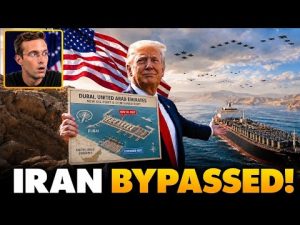
As President Trump plays hardball on the global stage, it seems he’s once again shaking things up—and probably leaving our European friends a bit dizzy in the process. The strategic Strait of Hormuz has become a scene of high-stakes political chess, with the U.S. launching another wave of airstrikes against Iran. While the initial plan was to impose a 20% toll on shipping through the Strait, the administration had another trick up its sleeve, switching gears to secure larger trade and investment promises from Gulf allies instead.
One has to admire the blend of strategy and improvisation at play here. President Trump reasoned that it’s not fair for the U.S. to guard this global choke point just for China and others to reap the benefits. Therefore, rather than collecting loose change from tolls, why not simply ask neighboring countries to shower America with investment? Who needs a toll when you can have billions in trade benefits?
In a surprising twist for those expecting an isolationist America, the Gulf states —like Saudi Arabia, UAE, and Qatar—are lining up to spend hefty amounts on their new best friend across the Atlantic. Meanwhile, Trump’s earlier meeting with the Iraqi Prime Minister highlighted a growing bond and marked another step in the effort to isolate Iran. It seems Iraq is now more willing to distance itself from its neighbor, while the Gulf nations eye Iran’s pesky proxies in places like Yemen. It’s a diplomatic dance that’s part careful negotiation and part third-grade dodgeball, but it’s inching closer to reshaping the Middle East’s old dynamics.
Some might raise an eyebrow—or both—at Trump’s changes. After all, tolls on international waterways sound like the dream of a global road planner gone rogue. But while Europe scratched its mighty chin thinking about it, Trump made his move. He wasn’t going to wait for anyone to join in a grand chorus of ships in the Strait of Hormuz. So instead, he threw a curveball, dropped the toll idea, and secured investment assurances without any harmful side effects—aside from possibly giving the Ayatollah a headache.
Now, let’s be honest, Trump’s bold strides have also been painting him as a villain in some circles; the villain who, with every step, seems to be three steps ahead. His critics fret about the inflation rates and economic implications, while others fret about nothing because they’re too busy watching the inflation rate trending downward—probably chuckling at the irony. In the end, the airstrikes and oil sanctions continue to pile pressure on Iran, all while America finds itself cashing in on diplomacy and trade innovation rather than toll booth fees.
It’s a world of shifting alliances and strategic pivots, but one thing appears evident: President Trump has his eye on the prize, and he sure isn’t playing by anyone’s rulebook but his own. His unorthodox tactics and penchant for turning the tables seem to bring more than a political win—they bring theater, and isn’t that what global diplomacy thrives on these days?