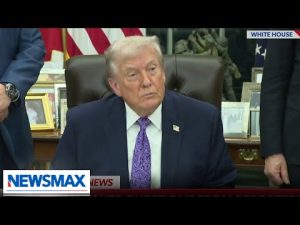
In a world where technology is racing forward at breakneck speed, the issue of artificial intelligence (AI) is more important than ever. Recently, a conservative news channel focused on a discussion regarding AI and its implications, particularly for the United States and its competition with China. The topic was ignited by the leading Republican figure, who shared insights about the double-edged sword that AI presents. On one hand, it’s a critical element in maintaining supremacy over global competitors; on the other, it poses potential threats that must not be ignored.
The discussion emphasized that the U.S. is currently leading the charge in AI development, leaving China and other countries scrambling to catch up. However, this lead is not something that can be taken for granted. If the U.S. falters in its pursuit of AI advancements, it wouldn’t just be a setback—it would be a boon for rival nations, particularly China. With estimates suggesting that AI could contribute up to 60% of our economy in the near future, the stakes couldn’t be higher. The investments pouring into construction and technology are substantial, and any slowdown could have rippling effects across multiple sectors.
Moving beyond economic implications, the conversation segued into the U.S. actions against Venezuela, a country notorious for its troubled governance. The recent seizure of a tanker highlighted a broader campaign against Venezuela, which extends beyond merely addressing drug trafficking. The conversation took a serious turn as it was revealed that a significant number of individuals entering the U.S. from Venezuela included prisoners, gang members, and individuals with dubious backgrounds. This invasive influx has raised alarms, especially concerning the violent gangs emerging from Venezuela’s prisons.
As the news unfolded, the President made a striking point about crime prevention, noting that drug trafficking by sea had seen an impressive reduction. It was mentioned that this decline reached a staggering 92%, though the remaining 8% of traffickers remained a mystery. It’s a sharp reminder that while progress is being made, the battle against drugs and associated crime is ongoing. Future plans to tackle land-based drug trafficking are also on the horizon, further indicating a strong stance on national security and public safety.
The conversation also touched on political strategies back home, specifically in Indiana, where a controversial redistricting plan was recently rejected by the state Senate. This was a blow to Republican aspirations, as the President pointed out that he had won the state in previous elections by landslides. A certain political leader’s opposition to the redistricting effort was labeled as a significant mistake, with implications that missteps could lead to dire consequences in upcoming primaries. It’s a classic case of how politics can complicate even the most straightforward of strategies—sometimes leaving constituents scratching their heads, pondering what went wrong.
Overall, the discussions surrounding AI, international relations, and political maneuverings paint a picture of a nation at a crossroads. It’s clear that technology and governance are closely intertwined, as solutions to one issue can unknowingly complicate another. As the President emphasized, maintaining the U.S.’s position as a leader while safeguarding its citizens from various threats is crucial. With such high stakes, the hope is that America can navigate these challenges effectively, keeping its citizens safe and its economy thriving, while simultaneously outsmarting its rivals on the global stage.