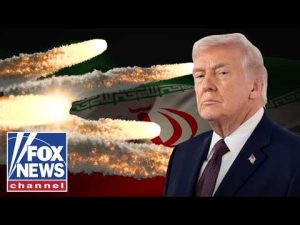
In recent discussions surrounding U.S. foreign policy, former President Trump’s approach to military interventions has sparked a polarizing conversation. Contrary to what some political ideologies suggest, Trump advocates for a clear-eyed understanding of conflict: if the United States engages in war, there should be tangible benefits, particularly when it comes to oil resources. This isn’t merely bravado; it’s rooted in a pragmatic assessment of history and economics.
Historically, the philosophy espoused by Wilsonian neoconservatism suggests that America should engage in military actions solely for humanitarian reasons, often ignoring the principle of national interest. The belief that the U.S. should pursue wars without any expectation of gain has led to disastrous outcomes in places like Iraq and Afghanistan. In these conflicts, the narrative indicated that the ultimate goal was to liberate oppressed peoples. However, when it came time to justify losses and expenditures, many were left asking, “What did we actually achieve?”
President Trump has boldly questioned this approach. During his tenure, he raised eyebrows when he suggested that the U.S. should have seized Iraqi oil after military involvement. He argued that controlling the oil would not only serve American interests but also prevent the rise of terrorist groups like ISIS, which funded their operations through oil revenues. This perspective counters the narrative that American military engagement should be altruistic and devoid of self-interest. If only the policymakers of the past had shared this view, the landscape of the Middle East might look very different today.
The potential benefits of securing oil resources do not end with just Iraq. In regions like Venezuela, Trump’s administration took decisive steps to reclaim control of seized oil supplies. The seizure of nearly two million barrels of oil signifies a shift toward a more unapologetic stance on resource management in global politics. By asserting that the United States should retain control over these oil supplies, Trump sends a message about prioritizing national interests while addressing the financial and humanitarian ramifications of conflict.
Understanding this approach requires acknowledging a fundamental fact: no Middle Eastern regime has independently developed its own oil resources. The oil wealth in these regions was largely established through foreign investment and technology. When the U.S. and its allies intervened, it ultimately shaped the geopolitical landscape. By failing to retain ownership of these economic assets, past administrations left a vacuum that hostile entities like ISIS could exploit, leading to more chaos and instability.
In the end, Trump’s proposal may seem brazen to some, but it’s a reminder that American foreign policy must be grounded in realism that takes into account both moral imperatives and strategic interests. It’s about time that policymakers move beyond idealistic notions and recognize that, in the realm of global politics, tangible gains can accompany acts of intervention. Whether it’s Iraq or Venezuela, the principle remains: if America is going to put boots on the ground, it might as well make sure the country is getting something out of it—preferably oil, and, ideally, a more stable world.