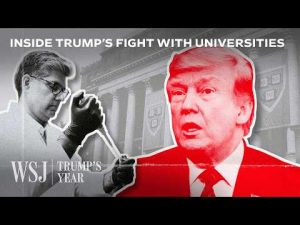
In today’s higher education landscape, tensions are running high, especially at institutions like Harvard University, which has found itself at the center of a heated controversy under the Trump administration. Researchers, like neurobiology professor Bob Data, rely heavily on federal funding to drive their scientific work. The unprecedented actions taken by the Trump administration, particularly the cancellation of billions in federal research grants, have left many in the academic community feeling anxious and uncertain about the future of their work and the integrity of their research.
Professor Data, who works with diseases like Alzheimer’s and autism, expressed his concerns about how the funding freeze impacts innovation. Many researchers worry that their ability to conduct long-term, crucial experiments is at risk because of the federal funding cuts. With two-thirds of his lab’s budget coming from federal grants, the stakes are incredibly high. This funding freeze is not a minor hiccup; it threatens to slow down important scientific progress that could lead to breakthroughs in understanding and treating various illnesses.
The Trump administration took a hard stance against what it deemed as radical leftist ideologies taking root in universities. This crackdown began in earnest after a rise in pro-Palestinian protests on campuses linked to the Israel-Hamas conflict. President Trump made it clear that universities needed to become environments that ensure the safety and academic freedom of all students, particularly Jewish students who have faced harassment. In response to heightened anti-Semitism, Trump vowed to tie federal funding to the enforcement of civil rights laws and to initiatives promoting viewpoint diversity on campuses.
As the administration pushed more aggressively, it set forth a “Compact for Academic Excellence in Higher Education” aimed at reforming how federal funds are allocated to universities. This compact seeks to ensure that the government nurtures environments that reduce the influence of political ideologies in academia. Critics claim that these moves undermine the independence of institutions and threaten the foundational principles of higher education in America. Despite the pushback, the administration remains determined, believing a realignment of academic priorities is necessary to balance the political left’s influence on campuses.
Interestingly, amidst these turbulent developments, some universities have complied with the demands laid out by the Trump administration. Columbia University, among others, has reached settlements to restore federal funding, while Harvard has opted for a more defiant approach by suing the administration. The conflict raises significant questions about the future of higher education funding and how research—especially that requiring significant investment—will be sustained through these political wranglings.
The ramifications of these actions could have long-lasting effects, not only on academic research but also on the economy as a whole. Reduced funding impacts the next generation of scientists who are eager to push boundaries and explore new frontiers. Researchers like Professor Data worry that if U.S. institutions don’t maintain their leadership role in science and innovation, the global center of gravity for research could shift toward countries like China or those in Europe, where investment in science remains robust. The battle for academic integrity and funding appears to be far from over, with many eyes focused on how it will unfold amid ongoing legal challenges and political maneuvering.