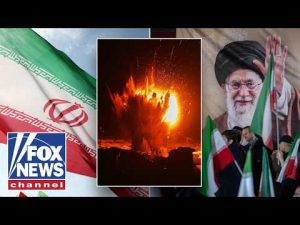
In the rich tapestry of global geopolitics, there are always those moments that seem almost too theatrical to be true. Picture this: President Trump is once again in the center stage, this time playing his role as America’s very own forceful negotiator at the peace talks in Switzerland. It’s safe to say that when it comes to dramatic flair, no one does it quite like him. As the ongoing talks are broached, the big news involves a rather attention-grabbing statement about the Strait of Hormuz. The president seems to have a simple plan—if Iran, already posturing its mischief, tries anything fishy with the strait, the U.S. will swoop in like its “guardian angel,” imposing tolls and snagging a solid slice of the oil pie for ourselves.
Now, let’s be clear, the Strait of Hormuz is no ordinary piece of real estate. It’s a critical waterway, and any threat of closure would send the price of oil soaring. But Trump, being Trump, has managed to package this whole situation into what sounds like a business deal. How very American! He’s talking about possibly taking a whopping 20% of the oil that transits through the strait. It almost sounds like the U.S. is about to open a drive-through toll booth in the middle of the ocean. One can almost envision the oil tankers lined up, waiting for their number to be called. “Next up, tanker 247! That’ll be 20% of your cargo, thank you very much.”
And yet, there’s more to this saga. There’s a touch of the classic ‘good cop, bad cop’ routine unfolding on the world stage. J.D. Vance seems to be holding court with a more diplomatic tone over in Lucerne. Meanwhile, the president is taking the tough talk route, warning Iran in no uncertain terms about the consequences of closing the strait. Of course, there’s talk of nuclear enrichment too—which only adds to the drama. Iran’s insistence on enriching uranium doesn’t align with the world’s collective sigh of relief that’s expected once nuclear ambitions are curtailed. But Iran’s president, in classic form, is having none of it, insisting on continuing on the path of enrichment.
The tension isn’t confined to this one area though. Oh no, there’s a subplot involving southern Lebanon, where Israel and Hezbollah are at it again. After Hezbollah struck and killed Israeli soldiers, Israel responded with airstrikes. President Trump, in his usual candid style, expressed his frustration with the situation, suggesting that Syria’s Assad might handle Hezbollah better. Here, one can’t help but chuckle at the visual of Assad diplomatically dealing with Hezbollah, perhaps inviting them for tea before trying to persuade them to cease hostilities.
While all this international political intrigue unfolds, the world waits with bated breath for the myriad scenarios that could play out. If Iran doesn’t budge on their nuclear program, the president has made it clear that there are options, and he seems to be keeping his hand close to his chest. Our leader, ever the businessman, has a 60-day extension card up his sleeve — although what exactly is on that card remains to be seen.
So, in the grand theatre of international diplomacy, where drama meets reality, where the stakes are as high as the oil barrels are plentiful, President Trump is certain to keep everyone on their toes. Perhaps it’s time for the world to grab some popcorn and watch, as geopolitical shenanigans unfold with a flourish befitting of a prime-time drama—a drama that decisively underlines the notion that politics, rather than just serving the realm of facts and figures, can sometimes be as entertaining as that television show we just can’t stop watching.