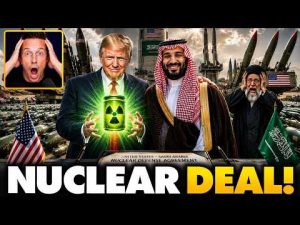
In a significant development from the Middle East, President Trump has announced a nuclear deal with Saudi Arabia, marking a bold move that could reshape the geopolitical landscape in the region. The agreement aims to establish a civilian nuclear program for the Saudis, which might even pave the way for uranium enrichment within the kingdom. While this plan is being pitched as a stabilizing move, the reality suggests a precarious situation, one that could set off an arms race in one of the world’s most volatile areas.
To understand the ramifications of this deal, it’s essential to consider the historical context. Saudi Arabia has long been an oil-rich nation, and its interest in nuclear energy stems not from a pressing need for power, but rather from an ambition to develop nuclear capabilities as a possible deterrent against regional adversaries like Iran. The Trump administration argues that if Saudi Arabia doesn’t develop its nuclear capabilities through the U.S., they may turn to nations like China or Russia for support, thus creating a greater threat to U.S. interests. However, the reality is that handing nuclear capabilities to an unstable region is like giving a match to a toddler playing in a fireworks factory.
It is pertinent to note that the Saudi monarchy’s stability is heavily reliant on American military support. A sudden shift in power, whether from within or as a result of external pressures, could lead to disastrous consequences. If the Saudi regime were to collapse and be replaced by a more Islamist-oriented regime, the proliferation of nuclear weapons could become an imminent risk, heightening tensions not just in the region but across the globe. The mere thought of a nuclear-armed Muslim Brotherhood would give anyone pause for thought.
Furthermore, it is crucial to address the paradox presented by U.S. policy. As it stands, America possesses substantial leverage over Saudi Arabia, primarily due to military and intelligence support. If the Trump administration is serious about promoting peace rather than provoking a nuclear arms race, it should leverage this influence to encourage Saudi Arabia to normalize relations with Israel through the Abraham Accords, rather than giving them the keys to the nuclear car. After all, why give a toddler a Ferrari when they struggle to ride a bicycle?
The ultimate goal should not merely be about supplying nuclear technology for profit but rather about eliminating the Iranian threat once and for all. Ending the ambitions of Iran’s nuclear program would not only make the case for a Saudi nuclear program moot but could also stabilize the region, leading to lower energy prices and improved relations among key players. A stable Middle East would deprive adversaries of their leverage, thus minimizing the risks associated with energy dependence and geopolitical instability.
In conclusion, while the desire to engage Saudi Arabia through a nuclear deal may appear well-intentioned, it is a path fraught with peril. By granting the Saudis nuclear capabilities without preconditions, the U.S. risks not only fuelling an arms race but also elevating an unstable regime’s power to potentially catastrophic levels. The answer lies not in nuclear diplomacy but in a decisive commitment to neutralizing the Iranian threat. Only then can America safeguard its interests while ensuring a safer and more prosperous future for all nations in the Middle East.