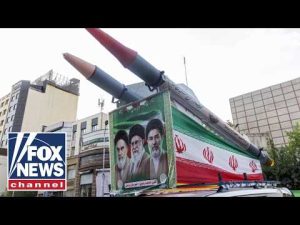
In the ever-tumultuous saga of the United States and Iran, the Trump administration has unfurled what is being heralded as the most stringent sanctions in history against Iran. The plot, as expected, thickens with the new “economic D-Day” initiative, which is a testament to the administration’s relentless pursuit of victory over a country that has long been in its crosshairs. Treasury Secretary Scott Benson has made it crystal clear that the White House aims not just to dent, but to dismantle Iran’s military capabilities and nuclear ambitions. Apparently, the goal isn’t just to rattle sabers but to take a wrecking ball to the Iranian economy, which is already teetering on the brink of collapse with its currency hitting all-time lows.
This economic storm is brewing as the beleaguered Iranian rial nosedives, crossing the threshold of two million to one US dollar. While it might seem like a number game to the casual observer, this signals an alarming inflation that grips the country’s economy. In the wake of these impending sanctions, Iran’s Supreme National Security Council hasn’t hesitated to rattle its own sabers. They’ve taken to social media, vowing that if the economic war persists, not a single drop of oil will exit the Persian Gulf. It’s as if they’re saying, “You want to play hardball? Well, two can play that game.”
Meanwhile, the United States, exhibiting a level of patience rarely seen in toddlers at a candy store, is beefing up its naval presence, ensuring that oil continues flowing through alternative safer routes. They’ve even gone so far as to redirect 70 commercial vessels using a new southern passage. At this point, one might think Iran is the Titanic, and the US is dutifully manning the lifeboats, ensuring the valuable cargo reaches its new destination. Undoubtedly, this economic blockade aims to squeeze Iran into submission and tumble its regime like a house of cards.
As President Trump asserts that the Strait of Hormuz is practically an American territory, one has to wonder if sovereignty is merely a suggestion these days. It’s the kind of bold declaration that suggests the United States is marking its territory, and it won’t back down until a favorable deal is on the table—one presumably written in plain English with just as much flair as the President’s tweets. The USS Abraham Lincoln is making its triumphant return after a record-breaking deployment, swapping places with the USS George Washington. The military prowess of the US is in full exhibition mode, a nod to anyone paying attention that Uncle Sam means business.
The world sits on the edge of its seat, wondering if these sanctions are the lever that finally tips Iran into submission, coercing them into a deal. Or are we segueing into yet another chapter of this soap opera, watching Iran try to rally its resources to withstand the pressure? With each twist and turn, it becomes clear that this conflict is a game of high stakes diplomacy—or perhaps, more accurately, a game of chicken. With economies and oil at play, even the audience may not know if the script is heading for a dramatic deal or a fiery showdown.