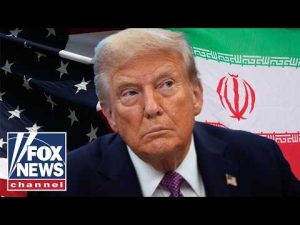
In the midst of political theatrics and military posturing, President Trump is taking a page out of the Rolling Stones’ playbook: time is on his side, or at least he’s betting it is. The President’s recent remarks made it clear that he’s in no rush to fashion just any deal with Iran; he has his eyes set on something far greater. The art of this deal, apparently, involves waiting out opponents he dismisses as lacking strategic unity, and armed with nothing more than bravado and empty threats. Of course, when he talks about making a great deal, one can almost hear the skeptics’ eyebrow raising halfway across the globe.
In this strategic chess game, Trump’s administration holds the initiative, or so they claim. While the Iranian foreign ministry sings one tune saying all is well in the Strait of Hormuz, the Iranian Revolutionary Guard Corps Navy abruptly cuts in with discordant notes, signaling otherwise. This lack of coordination within Iran is perceived as weakness by the U.S., which is flexing its military muscle by sending a third carrier strike group to the region. For Washington, it’s a straightforward military puzzle?solvable with patience and a few warships, they say?all part of maintaining pressure on Iran to play by America’s rules.
The Iranians, on the other hand, seem to draw confidence from somewhere inscrutable to American sensibilities. While asserting their grasp over the Strait of Hormuz?a crucial maritime passage?prompts an amused skepticism from Trump and his team. There’s skepticism that the Iranian navy’s muscle could match even some fast-moving drug boats off the Venezuelan coast. After all, the U.S. already paraded a couple of guided missile destroyers right through those waters just to make a point: we know where to look for threats, and it’s certainly not under the imaginary might of Iran’s naval forces.
Iran’s bravado isn’t confined to sea lanes either; there’s grandiosity in its diplomatic rhetoric, as well. According to the Iranian speaker of parliament, Trump’s tactics resemble a siege, an effort to cast negotiations in the light of surrender. He warns of new cards ready to be played?cards not unlike the pufferfish trying to appear larger than life. To America, this sounds more like an invitation to selectively whittle down Iranian capabilities, piece by piece. There’s a dry-eyed clarity in America’s strategy: let the Iranians puff up; it only makes for an easier target.
In the power dynamic between the U.S. and Iran, the current chapter might aptly be called, “Waiting is the Hardest Part.” For Trump, the strategy revolves around economic and military pressure, betting on Iran’s irrationality to push them to the negotiating table. The U.S. is banking on a long game, where patience is more powerful than any quick retaliation. Whether time indeed sides with Trump remains to be seen, but for now, he’s playing the waiting game—and the world is watching to see who will blink first.