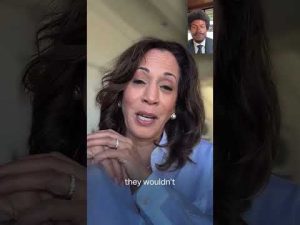
In the current political climate, discussions around race and representation have taken a sharp turn, especially within the Democratic Party. Recently, former Vice President Kamala Harris found herself in a conversation with Tennessee representative Justin Pearson, who has garnered attention for his theatricality when advocating for racial issues. This dialogue, fraught with accusations of systemic racism, paints a rather curious picture of today’s political landscape, where the narrative often oversimplifies complex social dynamics.
First off, let’s unpack the notion that America is suffering from deep-rooted institutional racism, a claim heavily pushed by some leading Democrats. Harris and Pearson argue that the solution lies in Harris’s ascension to the presidency, implying that her leadership would somehow eradicate these supposed injustices. This is a bold assertion; it presumes that simply placing a person of color in the highest office would automatically address systemic issues. It conveniently overlooks the fact that policies, not just individuals, shape society. Without a clear plan and a willingness to engage in dialogue about actionable solutions, these claims risk being seen as political theatrics rather than genuine service to the community.
Additionally, Pearson’s comments regarding the recent redistricting efforts in Tennessee raise eyebrows. By suggesting these changes are a deliberate attempt to disenfranchise Black voters, he is engaging in a familiar narrative—one that alleges systemic cheating rather than addressing the reality of political strategy and representation. It is crucial to understand that redistricting is a complex process often driven by demographic changes and population shifts, not solely motivated by racial animus. To categorize such actions solely as acts of “backdoor racism” oversimplifies a nuanced political decision and can lead to misplaced anger among constituents.
Furthermore, Representative Ayanna Pressley’s comparison between the current administration and historical slavery is not only alarming but also factually questionable. Her statement—that the administration would prefer Black Americans to pick cotton rather than elect a president—serves more as a sensationalized rhetoric than a sound argument. This kind of hyperbolic language does little to foster constructive dialog about race and instead risks alienating individuals who could be allies in the fight for racial equality. After all, lumping together complex issues into extreme soundbites may seem engaging but lacks the nuance necessary for genuine progress.
It’s also important to highlight the irony present in these discussions. The insistence that systemic racism is perpetuated by current political strategies ignores the fact that Democrats have held significant power in various regions—including Tennessee—facing challenges about representation and equity. The focus should be on collaboration and finding solutions rather than pointing fingers and casting blame. If the intent is truly about improving the lives of Black Americans, then engaging in honest discussions about challenges and solutions is far more productive than the theatrical performances often showcased in media.
Ultimately, the conversation surrounding race, representation, and systemic change requires more than just rhetoric; it demands a commitment to understand the complexities at play. Political figures should avoid crafting narratives that divide and instead seek to unify. If the goal is indeed progress, it will take more than catchy phrases and dramatic performances; it will take genuine effort, open minds, and a willingness to work together for the betterment of society.