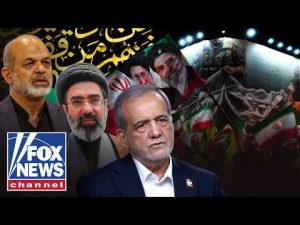
In the thrilling world of international diplomacy, it seems we have a recurring guest star who can’t help but steal the spotlight: Iran. This time, the plot thickens with their latest understanding agreement, raising eyebrows and skepticism in equal measure. As Mike Pompeo, former Secretary of State and now a familiar face on TV, puts it, the supreme leader of Iran is finally making an appearance now that he feels a bit more comfortable—or perhaps just a tad overconfident. It’s almost like he’s taken a cue from an airline commercial, moving freely around the cabin since the new deal has slipped into place.
Now, the Iranian regime appears as fractured as a soup cracker, with differing opinions floating around like paper airplanes. The supreme leader may have as much to say as a silent movie star, while the real power—the Iranian Revolutionary Guard Corps and its allies—seems to march to the beat of a different drum. One wonders if the agreement that supposedly binds everyone together is really just a piece of paper ready to be crumpled into a ball and tossed into the recycling bin of history.
Enter Vice President Vance, who eagerly draws contrasts between this shiny new deal and the much-maligned JCPOA from the Obama era. In his view, the differences could fill a grand canyon, from banning uranium enrichment to ensuring no American dollars flow into Iranian coffers. It all sounds as promising as a viral cat video, but one must wonder if the reality will live up to the hype. After all, writing promises down doesn’t necessarily translate them into action—unless, of course, it involves getting their enriched material sent on a one-way trip to oblivion.
Pompeo remains steadily skeptical, likening Iran’s supposed promises to a land of make-belief. They say they’re not pursuing nuclear weapons, but it feels more like a toddler’s vow not to touch the cookie jar. Moreover, the three M’s—Missiles, Money, and Moderates—are top of the mind. Allowing Iran access to more funds, regardless of the currency, may very well fuel their ambition, like feeding a stray cat only to find a feral colony on your porch. As for the mythical Iranian moderates, Pompeo’s take mirrors that of someone searching for unicorns in a field of goats.
Secretary of State Marco Rubio also comes into focus, his demeanor scrutinized like broccoli on a child’s dinner plate. His silence on the matter hasn’t gone unnoticed, but Pompeo dodges making judgments based on glum-looking images. Rubio had previously expressed his concerns about Iran’s missile program, which is now somewhat like gifting your neighbor a set of barbells when they keep talking about going to the gym but never seem to make it there.
On the broader stage, President Trump also channels his enthusiasm for international relations, giving Israel a supportive nod as they face challenges from an emboldened Iran-backed Hezbollah in Lebanon. In the eyes of the President, Israel should be more concerned about missiles flying across their borders than figuring out if they’re the problem. In the world of geopolitics, sometimes it’s about picking your battles, but at other times, it’s about making sure the rockets don’t choose you.
As gas prices tick upwards and align with stock market roller coasters, Trump’s strategy seems aimed at relieving pressure while keeping a wary eye on Iran, preventing them from making a buck off their oil reserves. There’s an emphasis on maintaining American energy dominance, a testament to balancing the delicate, but ever-so-awkward, dance of international politics. In the end, Pompeo points out that while Iran has a chance to prove themselves ‘normal,’ history suggests the possibility of unicorn sightings still remains slim.