**The Pentagon’s Quirky Prayer: When Scripture Meets Cinema**
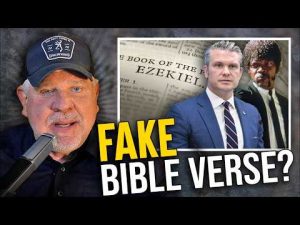
In the realm of political communication, it’s often a delicate dance, and when that dance involves a paraphrased scripture, things can get a little wobbly. Recently, Secretary of Defense Pete Hegsth found himself at the center of an amusing controversy after a prayer during a Pentagon service seemed to evoke the memorable monologue from Quentin Tarantino’s “Pulp Fiction.” As the days unfolded, Hegsth’s apparent mixing of pop culture with scriptural references left many scratching their heads, while the media spiraled into a frenzy, spinning tales and raising eyebrows.
The controversy kicked off when Hegsth, while discussing the daring rescue missions in Syria, paraphrased a well-known passage that many would recognize, albeit in its cinematic form. The original text from Shakespeare might inspire many Shakespeare enthusiasts, but in this case, it was Ezekiel 25:17 that took the stage, albeit with a twist. Instead of the straightforward scripture, Hegsth seemed to channel Samuel L. Jackson’s iconic delivery, which had a flair that only Hollywood could provide.
But let’s not forget that the real verses from the Bible pack a punch, too. They serve as a reminder that scripture is often stripped down to its core—without the dramatic flair that makes for a good monologue in the movies. While Hegsth’s intentions may have been rooted in sincerity, it’s hard to escape the irony of quoting a work of fiction while calling for divine intervention in a serious military context.
Once the media got wind of Hegsth’s message, it spread like wildfire—first igniting on social media before blazing through multiple news outlets. As it turned out, the wildfire originated from a Turkish site, only adding fuel to an already controversial fire. This led to bafflement among viewers, prompting them to wonder if the Secretary of Defense had just given a sermon straight out of “Pulp Fiction.” It was akin to Holy Communion getting interrupted by a Hollywood blockbuster—talk about mixing metaphors!
For those who keep a close eye on social media trends, the timing couldn’t have been more conspicuous. Earlier in the week, discussions about former President Donald Trump’s religious beliefs and a particularly cheeky Iranian video were swirling about. It was almost as if the cosmos conspired for a perfect storm of media scrutiny of political figures. Suddenly, questions arose—was Hegsth trying to channel biblical fervor or simply impersonating a character in a movie? And why were both the media and social platforms buzzing about it like bees on a sunny day at the park?
As the political hilarity ensued, some observers took a moment to reflect on the subtle undercurrents of distrust that these situations highlight within society. A chorus of voices reminded viewers not to simply jump on the outrage bandwagon. After all, true wisdom involves questioning the motives behind what’s presented and recognizing that social media can often serve as a battleground for misinformation and division. The powers that be, whether foreign or domestic, might prefer to see Americans squabble among themselves rather than unify in coherent thought.
In today’s fast-paced information age, the challenge lies not just in understanding the events but in discerning the truth amidst the noise. The lesson here? Stay vigilant, think critically, and maybe save the movie quotes for the theater. After all, in a world brimming with distractions, aligning across ideological lines is far more impactful than reenacting scenes from cinematic masterpieces. Remember, folks, to keep the popcorn for movie night, and leave the scripture—and the prayers—where they belong—in the church, not the script.