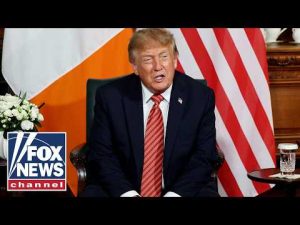
The political theater between the United States and Ireland continues as President Trump embarks on his European tour, making a noteworthy stop in Dublin. The relationship between these two nations has often been described as cordial and beneficial, or at least for one side. Ireland has reaped the benefits of a trade surplus, leaving the U.S. picking up the tab for what seems like a lavish, one-sided dinner. It’s a bit like your friend who always orders lobster when it’s your turn to pay, isn’t it? But President Trump seems poised to renegotiate the relationship dynamics.
While President Trump’s mission partly focuses on fortifying American interests, it is being overshadowed by a series of contentious issues. Immigration and trade are at the forefront of these disagreements, alongside looming foreign policy disputes. Ireland, like a stubbornly rebellious teenager, stands firm against some Western priorities. This posture hasn’t earned it a lot of friends among conservative circles, who see it as everything from naive to downright nonsensical. Yet, Trump’s agenda is clear: he’s looking to have constructive dialogues despite the backdrop of complex political undercurrents.
Joshua Trevinho from the America First Policy Institute painted a vivid picture of Ireland’s civic challenges. He highlighted the country’s troubling dance with anti-Semitism and its security freeloading habits. It seems like Ireland enjoys playing free bird when it comes to defense, expecting others to foot the bill while it sits back. Trevinho argues that President Trump faces a monumental task trying to steer Ireland back toward a path that aligns more with traditional Western values. It’s akin to trying to steer a reluctant donkey down a road it doesn’t want to travel – good luck with that, Mr. President.
But Trump’s dogged determination might prove fruitful. Across Europe, populist, nationalist sentiments are gaining momentum, as seen with Germany’s AFD party pushing against leftist tides. People are waking up and smelling the coffee, realizing that if they don’t change direction soon, they might end up somewhere unrecognizable. This tour could send a message to Ireland and beyond: the currents of change are strong, and Trump is the man eager to usher them in. No surprise there, as he’s never been one to shy away from ruffling a few feathers.
Could the Irish prime minister’s visit to the White House on St. Patrick’s Day have sown seeds for reconciliatory talks down the line? Time will tell. In a battle of progressive Sandcastles against Trump’s traditional castles, there are many layers to unravel. While President Higgins of Ireland has been openly critical of Trump, the economic realities facing Ireland may strangely dovetail towards a more cooperative outlook. With American leverage in trade talks looming large, this might just be another instance where pragmatism trumps idealism, and that could be downright entertaining to watch.