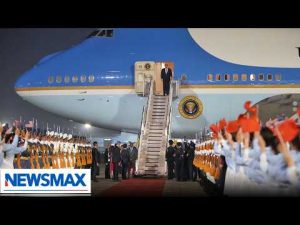
President Trump recently embarked on a significant two-day trip to China, and it didn’t lack for drama or attention. As he descended the stairs of Air Force One, he stepped into a moment that many believe could shape future relations between the United States and China. Young Chinese citizens greeted him with flags from both nations, creating an unexpected display of goodwill that surprised many observers. This trip comes at a time when China finds itself in a tight spot, especially concerning its alliance with Iran, which has recently become a hot-button issue.
Some analysts have pointed out that President Trump’s arrival in China was perfectly timed. With China under pressure due to its ties with Iran and struggling to maintain its influence in the Western Hemisphere, the stakes are high. Rumors have swirled about whether China is indeed supporting Iran in its ongoing conflicts. President Trump and his team aim to quell these fears amongst the U.S. populace, assuring everyone that they are keeping a close watch on Chinese leader Xi Jinping’s maneuvers. This time, it seems, China might have a bigger fish to fry as it tries to navigate the geopolitical landscape more carefully.
The United States is attempting to bolster its energy dominance and reduce reliance on foreign oil sources. President Trump has made it clear that purging Chinese influence from countries like Venezuela and Cuba, which have historically been sympathetic to Chinese and Russian interests, is a key part of his strategy. The former U.S. president playfully dubbed this initiative the “Donro Doctrine,” a cheeky nod to the Monroe Doctrine, which aimed to limit foreign influence in the Americas. President Trump has made significant strides to ensure that countries in the Western Hemisphere are less reliant on China, and this trip to China serves to further that agenda.
However, this situation doesn’t come without complications. While America is working hard to be energy-independent and lessen its dependencies, many U.S. consumers are still heavily reliant on affordable imports from China. This presents a tricky balancing act for President Trump. Though he aims to strengthen the nation’s economy and lessen foreign dependence, Americans have grown accustomed to the cheap goods that flow in from the eastern giant. This creates a tug-of-war between national security interests and economic realities that many people may not fully appreciate.
Complicating matters further is the mutual dependency between the two countries. China benefits from the sales of its exports to the United States, which fuels its own economic growth. Nevertheless, President Trump has argued that the U.S. cannot afford to be reliant on other nations for essential products, particularly after the hiccups the nation faced during the early days of the COVID pandemic, when shortages of critical supplies surfaced. He believes that bringing manufacturing back to American soil is not merely an economic goal but a national security concern as well.
As President Trump concludes this historic trip to China, there’s a sense of anticipation in the air. Will he be able to establish better relations while pushing back against China’s ambitions? Only time will tell if the groundwork he lays during this visit can bring about a new era of cooperation, or if it will further entrench the divisions that are already apparent in today’s global politics. It’s a complex puzzle, but one thing is for sure: the world will be watching closely as the saga continues.