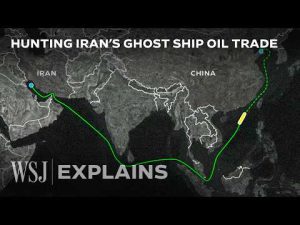
In recent weeks, the world has witnessed a concerning trend in oil trafficking, particularly linked to Iran’s shadow fleet. This fleet, which includes older and often rusty tankers, has been sneaking through one of the busiest shipping corridors in the world, off the southeast coast of Malaysia, right under the noses of major global powers. It turns out that despite sanctions imposed by the United States, these vessels are cunningly evading detection and continuing to move oil, primarily bound for China.
These ghost ships employ a range of tactics to avoid capture, including turning off their Automatic Identification System (AIS) tracking signals, using fake documentation, and conducting ship-to-ship transfers in international waters. This can make finding them akin to playing a game of hide and seek on a vast ocean, where the stakes are millions of barrels of oil. A recent report linked over 120 tankers laden with Iranian oil to this hidden network, collectively holding around 150 million barrels. That’s a staggering amount of crude just floating around, ready to be transferred to its destination.
One might think that a blockade would put a stop to this sort of activity, but the recent commitment by the United States to block Iranian ports is proving to be only a partial solution. While the blockade aims to prevent Iran from selling oil, the reality is that as long as there’s demand, these crafty vessels will continue to find ways to operate. Monitoring satellites have tracked these oil-laden ships moving seamlessly through the Strait of Malacca and the Singapore Strait, a chokepoint for nearly a third of global maritime oil trade.
When these ships reach a predetermined area off the coast of Malaysia known as the Eastern Outport Limits (EOP), they often go dark. This area sits outside Malaysian territorial waters, allowing these vessels to anchor without interference from authorities. This is where things get interesting; tankers on the surface seem to blend in with other shipping traffic, but underneath, they are engaged in a delicate dance of illegal trading. Here, they transfer their cargo, moving up to two million barrels of oil between ships before the final leg to ports in northern China, like Shandong and Dalian.
The situation is treated as a “gray zone,” where legality and illegality blur. Countries like Malaysia and Singapore have been accused of being complicit or at least turning a blind eye to these practices. It raises questions of sovereignty, jurisdiction, and the efficiency of international maritime laws. The ongoing trade clearly highlights the challenges the United States faces as it attempts to sustain the pressure on Iran and curb its oil revenue, which remains crucial for funding its government and operations.
As long as there are buyers for Iranian oil, the shadow fleet will continue to sail. This complex web of international trade demonstrates just how adaptive and resourceful illicit networks can be when faced with restrictions. Amidst the geopolitical maneuvering, it remains a stark reminder that some issues are more challenging to resolve than a simple blockade or sanctions. In the end, the enigmatic dance of oil tankers off the Malaysian coast reveals a significant challenge in the fight against sanctioned oil trades—one that may require more than just the usual tactics to navigate.