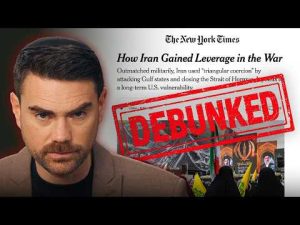
In today’s complex geopolitical landscape, the media’s portrayal of international relations often seems more like a soap opera than a serious analysis of power dynamics. This is particularly evident in recent discussions about Iran and China. Strangely, despite all the hard evidence to the contrary, both the New York Times and Washington Post are painting a narrative where these nations appear to be thriving against the US. But upon further examination, one must question how two nations with crippling weaknesses are somehow perceived as winning.
First, let’s look at Iran. The prevailing narrative suggests that Iran has gained leverage in its ongoing conflicts. However, the evidence tells a different story. Iran lacks a robust military presence, with its navy relegated to patrolling the bottom of the Strait of Hormuz and its economy barely limping along. The notion that Iran is winning seems to hinge on a narrow definition of victory—that is, surviving and creating a stalemate. But survival, especially when clinging to power by the skin of one’s teeth, hardly qualifies as a win in any meaningful sense. It is crucial to understand that maintaining control over the Strait of Hormuz does not translate to strength or stability; if Iran truly had control, its economy would be benefiting from the oil it could export, yet it finds itself unable to do so.
Now, transition to China. The media’s claim that China is somehow coming out ahead during this turmoil is bewildering. In reality, China is grappling with its own significant problems, including a demographic crisis and a staggering debt load. Furthermore, the idea that China is capitalizing on a conflict where it is simultaneously squeezed for resources from the West defies logic. If the war outcomes have favored one side over the other, it is more likely that China is merely treading water while desperately seeking oil supplies to fuel its own economy.
Amidst this circus of misrepresentation, voices within the media argue that the United States is bombing its own standing on a global stage. This analysis dangerously overlooks the progress made in US energy production, which has positioned the US as a key player in global oil exports. Rather than flailing, the US has ramped up its military readiness significantly, an essential move given the instability posed by adversaries like Iran and China. It’s easy for armchair analysts to overlook that weakening the US not only endangers its interests but could have wider implications, opening the door for adversaries to fill the power vacuum.
By fixating on the narrative of a US decline while glossing over the troubling realities facing both Iran and China, the media perpetuates a sense of helplessness. This approach raises the question: why would anyone advocate for a weaker America? The answer seems rooted in an ideological bias—one that ignores historical lessons that affirm that a strong America is synonymous with a stable world. The fact that some experts are expert at delusion does not make their theories any more credible.
In conclusion, while the conflict may have created temporary disturbances in the international order, the assertion that adversaries like Iran and China are somehow victorious is not just misleading—it risks undermining the very values and strategies that have historically kept the world in check. America’s strength is paramount, not only for its own citizens but for the stability of global affairs. Rather than surrendering to pessimistic narratives, it is crucial to recognize and support policies that uphold American power, inviting a more secure future for all. The world doesn’t need a weaker America; it needs a united front that champions strength, resolve, and a common sense approach to global friendships.